Thatcham’s Blue Plaques
Blue Plaques in Thatcham
Since 2018, Thatcham Town Councils Heritage Working Party has unveiled a new blue plaque annually, celebrating the heritage of Thatcham. Throughout the town, blue plaques mark the buildings, locations, and landmarks connected to the people and events that have shaped Thatcham’s history.
Read below to discover these plaques and the stories behind them. You can also step into the rich history of Thatcham by following the Blue Plaque Trail. Visit the Thatcham’s History Trails page for further information.
2018 – The First Mail Coach, The King’s Head
In 1784, John Palmer, a theatre manager from Bath, introduced the first Royal Mail Coach, which took only 16 hours to travel from Bristol to London. Horses were changed every 8 to 12 miles, and the coach accommodated four passengers inside, with additional passengers on top.
On August 3, 1784, the first mail coach service stopped to change horses at the King’s Head in Thatcham. This inn had been run by the Fromont family since at least 1770.
The success of this service led other towns to lobby for similar mail coach routes. Following Bath, York established a mail coach route between London, York, and Edinburgh in October 1784.

Unveiling of the First Mail Coach Blue Plaque at the King’s Head Inn on the 6th October 2018.
2019 – Women Councillors, Thatcham Parish Hall
Annette Louise Henry had been co-opted to Thatcham Parish Council in October 1912 becoming the first woman to sit on the council. However, it was Anna Munro Ashman and Isabella Pike (née Clark) who became the first women elected, on the 7th April 1919, by the residents of Thatcham to sit on Thatcham Parish Council. Although they campaigned under their maiden names, election rules required their married names to appear on the poll, which the blue plaque commemorates.

The Mayor and High Sheriff unveil 2019’s Blue Plaque flanked by two suffragettes!
2020 – Harry Lester, HiQ Tyres and Autocare
Born in Middlesex in 1903, Harry Lester started his career welding motorcycle frames later moving on to work with MG cars. During World War II, he was called up to the Special Operations Executive, where he designed gadgets for undercover agents, including the prototype for the Welbike, a folding bicycle used in various military operations. Post-war, Lester continued his automotive pursuits, moving to Thatcham in the 1950s and developing racing cars for the successful Monkey Stables racing team. Lester retired in 1972 but remained connected to his garage as a consultant.

2020’s Blue Plaque on the outside of Wiltshire Tyres celebrates Harry Lester, pictured here with one of the last Lester MG’s built.
2021 – Henwick Fruit & Flower Farm, Thatcham Garden Centre
Elizabeth “Lily” Hughes-Jones and Mary Peers had established a school for Lady Gardeners by August 1906. The school offered both practical and theoretical education. Practical courses included beekeeping, carpentry, horticulture, and jam making.
In the first decade of the 20th century, a French gardening craze swept the country, with the French gardening system taught at Thatcham making headlines in 1908. This involved growing vegetables like lettuce, radishes, carrots, and cauliflower being forced in glass-covered wooden frames and bell-shaped cloches. Notable students included Beatrix Havergal and Mabel Sowerby, the latter became a teacher at the school. The school became known as the French Gardens, it was operational until around 1957.

2021: The Mayor, Dr Christina Hill-Williams (President Berkshire Gardens Trust) and members of the Heritage Working Party at Thatcham Garden Centre.
2022 – Lieutenant-Colonel Urquhart, Station Road
In February 1940, land in Station Road, Thatcham, previously a tobacco store for W.D. & H.O. Wills, was requisitioned by the British Military for use as an Ordnance Depot. By 1942, American forces had taken over, it became the largest depot in the country, named General Depot 45. Spanning from Station Road to Newbury Racecourse, it included over 30 miles of railway track.
Lieutenant Colonel Vernon Watkins Urquhart became the first commander of the Thatcham Depot, but his tenure was short-lived. During a bombing raid on August 16, 1940, two high explosive bombs were dropped on Thatcham. Vernon, in the garden of his house at 141 Station Road, was killed instantly by shrapnel from one of the explosions. His house suffered damage, but his wife, inside at the time, was unharmed. The Newbury Weekly News of 22nd August, 1940, reported the bombing, noting human casualties, including Vernon’s death.
Vernon was buried three days later in Shaw Cemetery. Despite his death being recorded in the Army Roll of Honour (1939-45) as occurring while serving in the Royal Army Ordnance Corps, no official death certificate was issued.

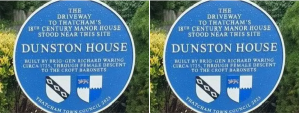
2023 – Dunston House
The Manor of Thatcham was purchased by Brigadier General Richard Waring in 1722, who had a mansion house built on land surrounding Dunston Field. The mansion, completed by 1725, was built of glazed brick with stone accents and featured gardens laid out in military formations, reflecting Waring’s career. The estate passed down through the family, via marriage into the Croft family. In 1797 the estate passed to another relative and was soon put up for auction. Failing to sell, the building was dismantled and sold for building materials. Materials from the demolished house were used in various buildings in Thatcham, including the United Reformed Church.
2024 – The Poplars
The Poplars, erected around 1744, was possibly built for the Baily family. Richard Baily, father to Francis Baily, resided here, and the building has been known as The Poplars since at least 1883.
In c.1909 Dr. Thomas Martin moved into The Poplars, which had previously been occupied by John Lester Sherrin. This marked the first recorded use of The Poplars as a doctor’s surgery. Martin was succeeded by Dr. Peter Warwick Ransom, MRCS LRCP MB BC.
Around 1946, Dr. Ransom left, and Dr. James Beagley, who had been working there, continued until the 1950s. He was later joined by Dr. Deborah M. Bradley-Moore and others, including Dr. Walker and Dr. David Holland. The surgery was the first in Thatcham to offer NHS services to the residents. The surgery closed in 1978 when the health centre opened. Today, the building is home to Cedar Dental Care.
2025 – Thatcham Army Depot, G45, Moorside Community Centre
Land on this site, including ground occupied by a tobacco store operated by W.D. & H.O. Wills, was requisitioned for military use at the outbreak of the Second World War. Surrounding public footpaths were diverted in September 1939, and in February 1940 the site was formally taken over by the British Army with Lt. Col. V. W. Urquhart as its first commander.
In November 1942 the depot was transferred to the United States Army and designated General Depot 45. The site expanded rapidly and reached its peak around D-Day in June 1944, when approximately 7,000 people were working there.
The depot was handed back to British control in May 1946, the last American depot in the country to be returned. Activity declined after 1964 and closure was confirmed in 1998. The final Beating of the Retreat was held in December 1999, and the depot officially closed in March 2000.